

In July of 2025, the White House proposed a 90,000-square-foot expansion to add the new White House State Ballroom. As President Trump described tents used for events as “embarrassing,” his administration has taken measures to pursue this plan. The BBC reported that the ballroom would include a “lavish interior including chandeliers and ornate columns,” and Donald Trump has said it would be able to hold 100 people.
While the President claimed that the construction of the ballroom “won’t interfere with the current building,” the East Wing was demolished in September of 2025. This has caused widespread controversy, receiving mixed responses from Republicans and Democrats.
The East Wing of the White House in Washington, D.C was first built in 1902 as the East Terrace under President Theodore Roosevelt and expanded in 1942 under President Franklin D. Roosevelt. This wing expanded and housed the offices and staff of the First Lady of the United States, the East Colonnade walkway, the President’s Theatre, and the Presidential Emergency Operations Center, which serves as an underground bunker securing the POTUS from national emergencies. Including the initial building and Truman renovations, the total amount spent on the development of the East Wing has amounted to roughly $150-200 million in today’s dollars. Yet none of these building efforts compares to the scope of renovations proposed by the current Trump administration. 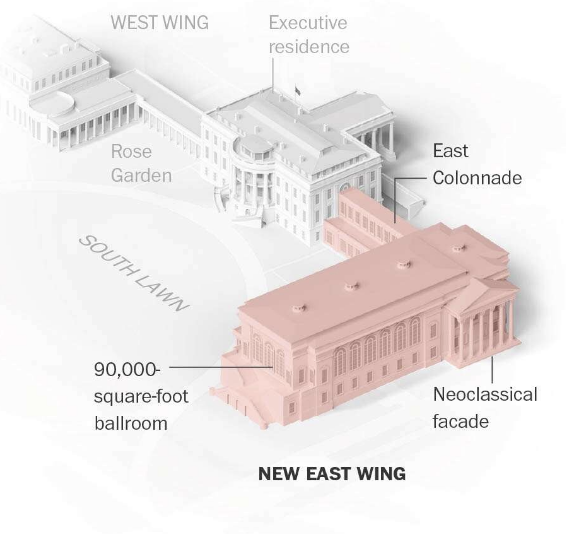
According to the Washington Post, the construction of the new East Wing is estimated to cost $300 million. Being funded by private investors and donors, the White House released the list of donors, including companies Google LLC, Amazon.com Inc., and individuals such as the Winklevoss twins. Although the names were publicized, the amount of money invested and donated was not disclosed.
House Speaker Mike Johnson has supported Trump’s plan, calling it “the greatest improvement of the White House in the history of the building.” While former First Lady and Trump’s opposing Presidential candidate in the 2016 election, Hilary Clinton posted, “It’s not his house. It’s your house. And he’s destroying it.” Historians also expressed concern, with the head of the National Trust for Historic Preservation sending a letter to the WH, citing how the new construction could overwhelm the classical design of the building and damage its historical integrity. In addition, as required by federal law, the plan has not been submitted to the National Capital Planning Commission (NCPC). The administration has claimed that a 1964 executive order allows the President to bypass the commission. Yet, after reporters pointed out the legal requirements, the WH said it would begin the process at an appropriate time.
As construction continues, plans for the WH State Ballroom have sparked a broader conversation about the transparency and overreach of the Trump administration. Regardless of political affiliation, this expansion marks one of the most significant and controversial changes to the people’s house. With legal and political challenges, the new East Wing will continue to raise questions of just how much Presidential authority can be extended over the White House.