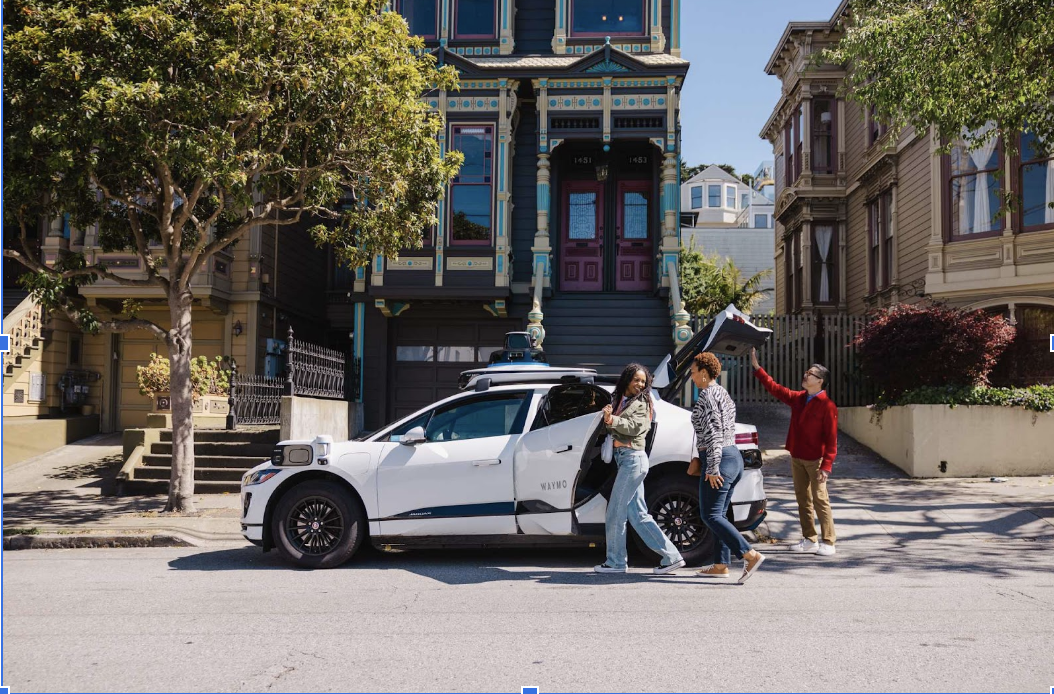
Waymo, the prominent self-driving robotaxi brand owned by Google, has big plans for expansion. On the company’s website, Waymo shares a roster of 13 major cities, including London, that the white Jaguars will be coming to in the near future. The list also includes San Diego, where Waymos have been spotted test driving. On their commitment to safety while expanding, Waymo shares “we compare our driving performance against a proven baseline to validate the performance of the Waymo Driver and identify any unique local characteristics. As needed, we then refine the Waymo Driver’s AI to navigate these local nuances—which are becoming fewer with every city,” describing the car’s process for adapting to new cities.
Waymo’s plans for expansion and Uber’s recent widespread addition of a “Women Preferences” feature expands ride share options for teenagers and women nationwide, ensuring greater safety for female riders. Additionally, in 2024 Waymo shared a study exhibiting that their autonomous vehicles are 7 times less likely to be involved in a crash causing a serious injury than vehicles with human drivers. With new ride share options and recent data illustrating the safety of autonomous vehicles, the future looks bright for the self-driving car industry. However, a recent incident regarding a bodega cat in San Francisco has turned public opinion against Waymo and other self-driving vehicle companies.
While Waymo is enticing to many potential riders, others fear the risks are too great. On October 27th of 2025, the beloved bodega cat Kit Kat, “the mayor of 16th street,” was killed by a Waymo outside of Randa’s Market in the Mission District of San Francisco. Kit Kat was a permanent fixture of the market who brought joy to both the local community and to passersby alike, and the neighborhood has greatly mourned his passing. Randa’s Market shared on Instagram, “we’re heartbroken. He [Kit Kat] brought warmth, smiles, and comfort to everyone who walked through our doors…. The store won’t be the same without his little paws padding around.” Kit Kat’s death has raised public concerns about the ability of Waymo taxis to react in real-world situations, despite Waymo’s sympathetic statement on the accident.
The brand Waymo, and other prominent autonomous vehicle competitors, originated with the first DARPA Grand Challenge in 2004. The challenge, sponsored by the Defense Advanced Research Projects Agency, promised a $1 million reward for the group whose autonomous vehicle successfully completed a 212 kilometer all-terrain course. Alex Davies, a former senior associate editor at WIRED, describes the 2004 race as a “motley assortment of driverless Frankencars: SUVs, dune buggies, monster trucks, even a motorcycle.” Fifteen modified vehicles competed in the 2004 challenge, and although none were able to complete the course, the race spurred ideas about the future of self-driving cars.
One DARPA competitor, Anthony Levandowski, went on to work at Google and became a key developer of the current self-driving robotaxi brand Waymo. Levandowski shares, “at the time, everybody was doing random things in labs and schools. So DARPA brought everybody onto the same focus of getting from point A to B.” Levandowski initially developed a self-driving car for an engineering TV show as a personal project, yet after his initial success with the vehicle Google became involved, expanding the project and transforming it into the current autonomous vehicle company, “Waymo.” Levandoski is no longer involved with Waymo, after founding his own autonomous vehicle company Otto, acquired by Uber in 2016, and becoming involved in a lawsuit with Waymo for stealing Waymo’s technology and trade secrets to benefit Uber. After serving time in prison, Levandowski now works as the CEO of Pronto AI.
Waymo was first allowed to drive in San Francisco without a safety driver by the California Public Utilities Commission (CPUC) in 2018, according to ABC7 News. This decision provoked pushback from the emergency responders of San Francisco, who found the presence of Waymos to be interfering in their work. Waymos were unfamiliar with how to behave in emergency situations, which could cause delays in an emergency response or create unnecessary traffic. City Fire Chief Jeanine Nicholson shares, “our folks cannot be paying attention to an autonomous vehicle when we’ve got ladders to throw. I am not anti-technology, I am pro-safety,” stating that presence of Waymos in emergency response situations endangers the safety of San Francisco residents.
Although the City of San Francisco pushed for less autonomous vehicles on the roads, the CPUC and DMV allowed Waymo to continue growing unchecked. Waymo taxis are now deployed in numerous cities across the country, including Los Angeles, Atlanta, Phoenix, and Austin, and Waymo is working to train their cars in other major cities. However, the recent incident in San Francisco involving Kit Kat is leading the public to wonder about the true cost of self-driving technology.